Building a Solid Foundation for University Success
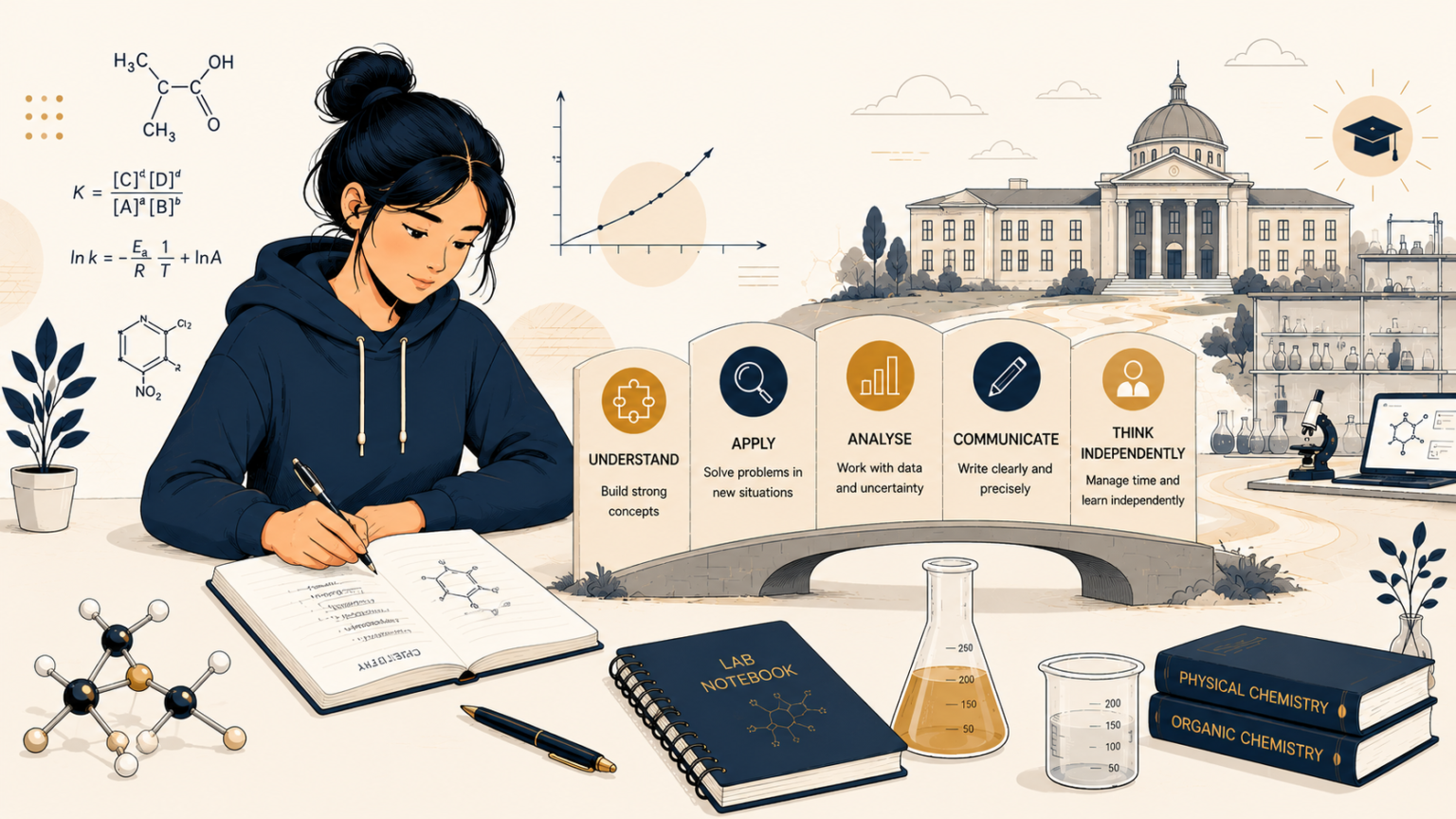
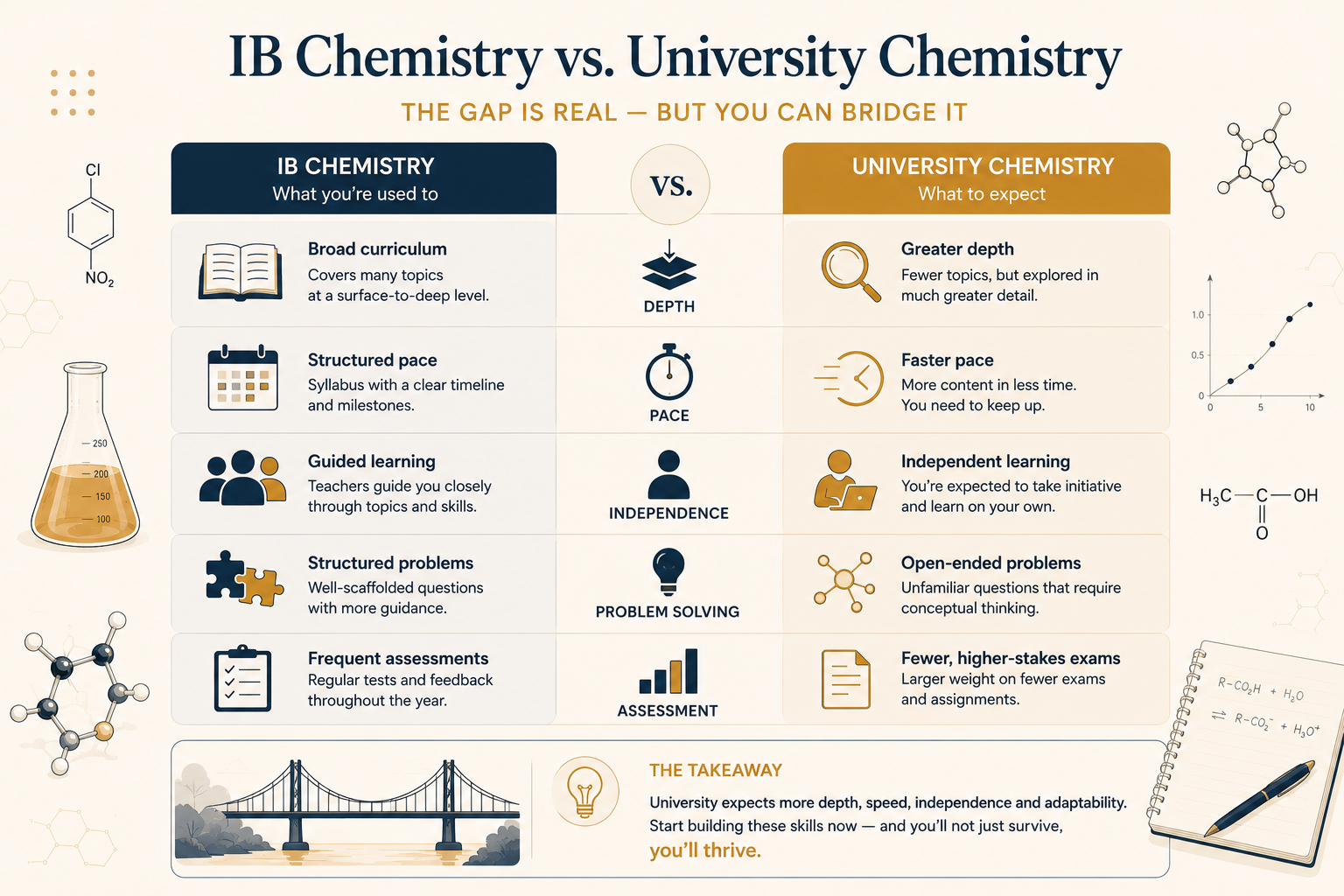
A common question is whether IB Chemistry truly prepares students for university. The honest answer is not about matching content, since first-year university chemistry introduces plenty of new material, no matter your background. What IB Chemistry really develops, when taught well, are transferable skills: solving problems independently in new situations, analyzing data through the Internal Assessment, writing clearly and accurately, and building the self-directed study habits that universities expect. These skills are what make the first year go smoothly or feel challenging.
The Skills That Actually Transfer (Not Just the Content)
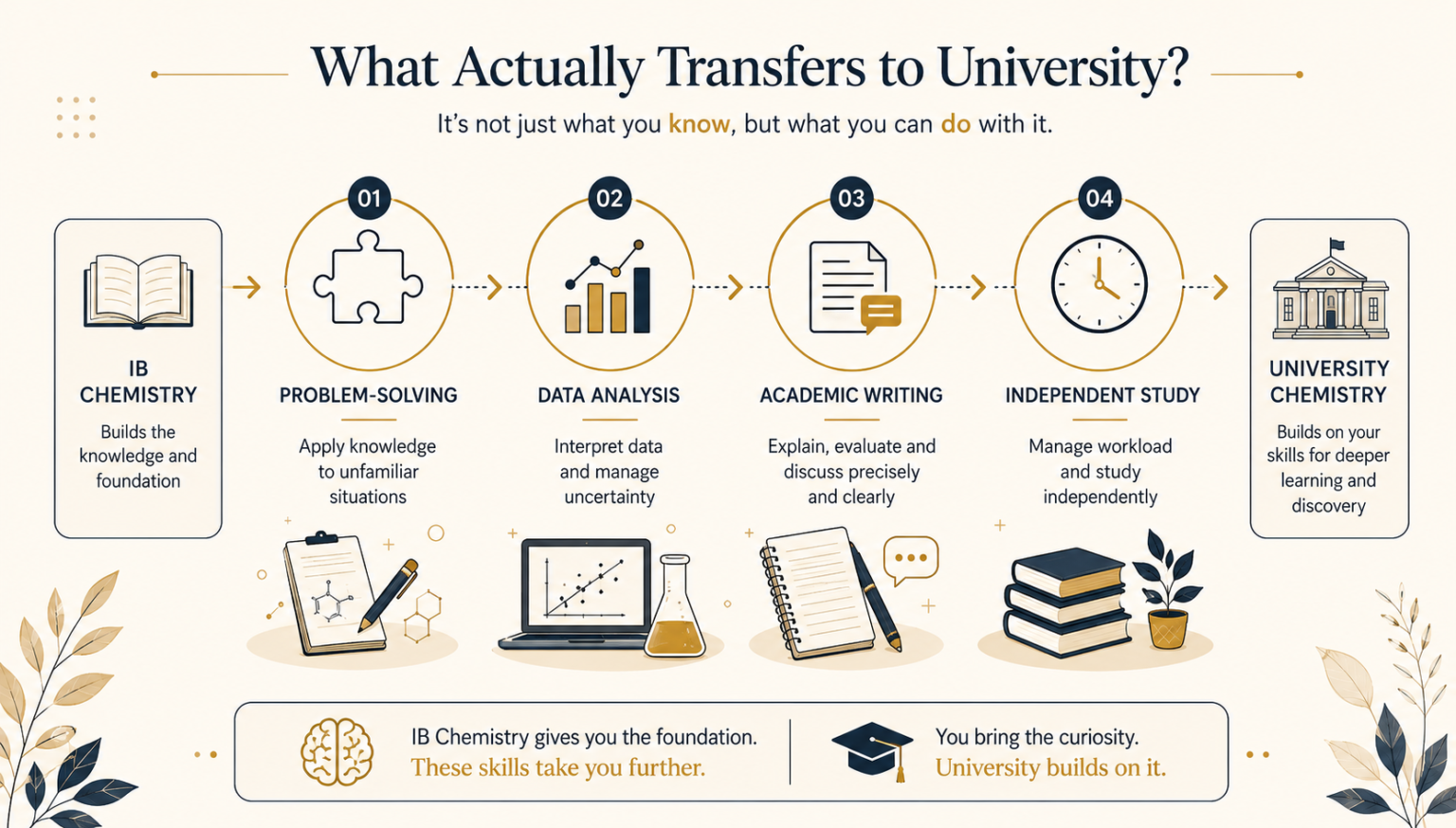
Independent problem-solving in new situations. IB Chemistry’s Paper 2 and Paper 3 questions are designed to make you apply what you’ve learned to unfamiliar scenarios, not just repeat memorized answers. This is the same skill university problem sets require, where you rarely get a worked example that matches your assignment.
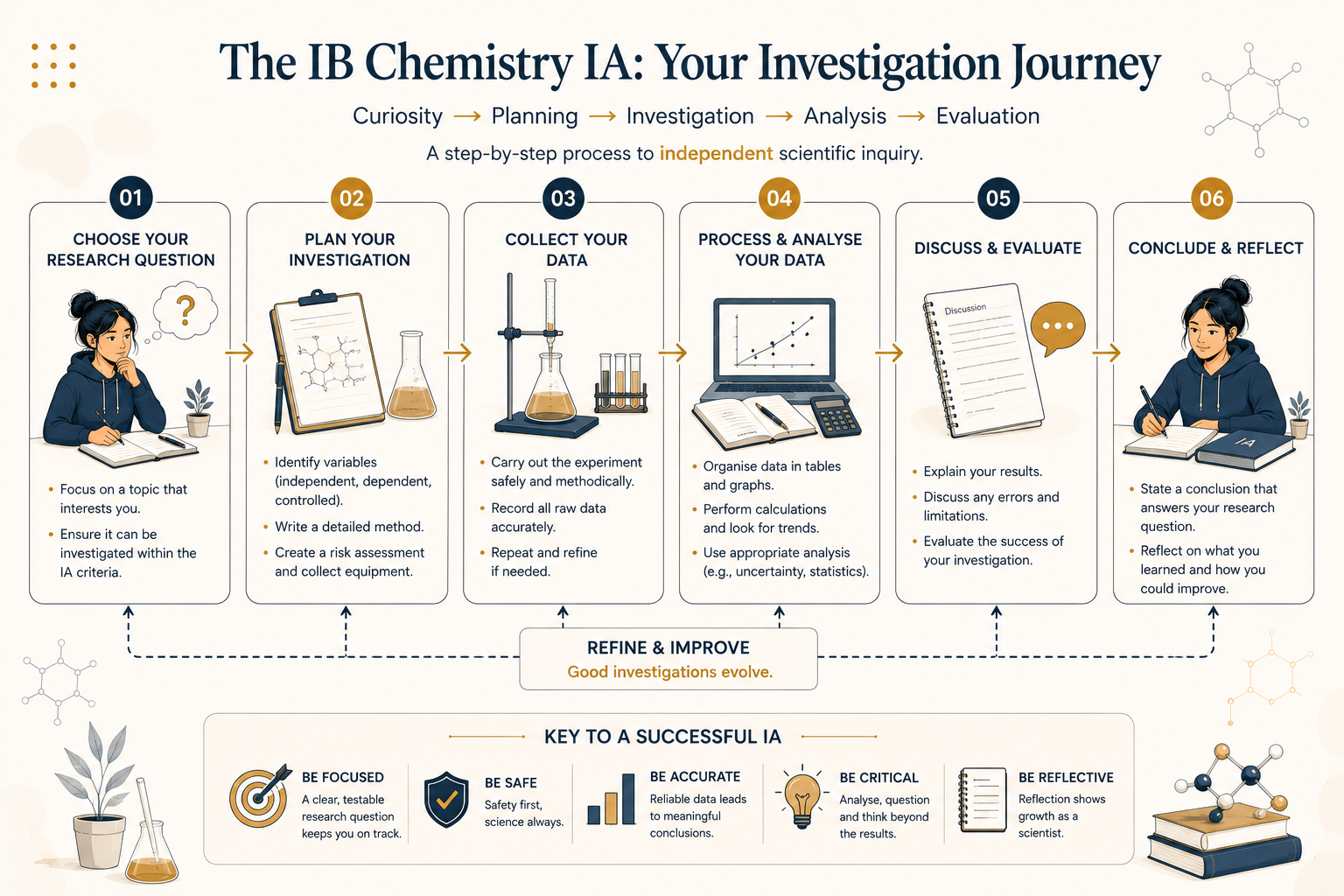
Data analysis and uncertainty. The IA asks you to work with real data, calculate uncertainties, and judge how reliable your results are. First-year university lab reports expect nearly the same approach. Many students face this level of detail for the first time at university, but IB students have usually practiced it already, with guidance and feedback.
Precise academic writing. Command terms instill a specific kind of writing discipline — “state,” “explain,” “evaluate,” and “discuss” all demand different structures and levels of depth. That precision carries directly into how university expects lab reports and exam answers to be written.
Self-directed pacing. Completing the two-year IB syllabus, along with five other subjects and the IB core, demands independent time management. This is much closer to how university terms work than a single-year, teacher-led course.
Where IB Chemistry Students Tend to Have a Real Edge
The IA is a unique preparation that many students underestimate. Doing a full independent research project—collecting your own data, analyzing it, evaluating limitations, and referencing sources—is something many non-IB students only experience in their second or third year of university. IB students usually complete this process before they even start university.
IB students are also more comfortable with open-ended, application-based questions instead of just recalling facts. This skill is often more important in university assessments than students expect.
The IA also builds a foundation in academic integrity that is easy to miss. It requires proper citation and honest acknowledgment of sources, following a real academic honesty policy. University standards for plagiarism and citation are even stricter and carry higher stakes, so having experience with these expectations, even on a smaller scale, helps reduce the surprise.
I’ve seen this firsthand: some of my former students have gone on to study Biomedical Engineering at Johns Hopkins, Karolinska Institute, and UCL. These competitive placements don’t happen by chance—they show the value of a foundation built on real understanding, not just memorized facts.
Where Gaps Still Show Up in First Year
It’s important to be honest, not just focus on the positives. University chemistry, especially physical chemistry, often moves faster and relies more on math skills like calculus and differential equations than SL or even HL IB Chemistry does. Students planning to study a lot of chemistry in university usually benefit more from reviewing math over the summer than from revisiting chemistry content.
Lab technique and equipment experience also vary widely between schools. Some students feel confident with hands-on lab work, while others are less comfortable, depending on what their school’s lab could offer. There’s also a big difference between having a syllabus that tells you exactly what to study and having a reading list where you must decide what you need. IB helps students start making this shift, but the full adjustment usually happens in the first year of university.
The way assessments are structured changes as well. In IB Chemistry, your grade depends mostly on a few big final exams, with the IA as the main ongoing assessment. University chemistry spreads assessments out over weekly problem sets, regular lab reports, and periodic tests. This system rewards steady effort each week instead of cramming at the end. Students who relied on last-minute studying for IB finals often need some time to adjust to this new approach, where falling behind week to week can hurt your grade.
How to Use the IA as University-Prep, Not Just a Grade Requirement
If your child is still working on their IA, encourage them to treat it as practice for university-level work, not solely as a requirement for their final grade:
- Write the methodology part so that it is clear and detailed enough for someone else to repeat the experiment.
- Take the uncertainty and data-processing section seriously, even if it feels tedious. This is almost exactly what a university lab report will expect in the first week.
- Practice writing an honest evaluation section by identifying real limitations and suggesting real improvements, instead of just using “human error” as a general explanation.
For example, a strong evaluation section does more than just mention that “human error” affected the results. It points out a specific source of uncertainty, like parallax error in a burette reading, estimates how much it might have changed the final value, and suggests a realistic improvement, such as using different equipment or changing the method. This degree of detail is exactly what university lab report markers want to see, and practicing it now does not affect your IA marks.
When approached like this, the IA becomes more than just a requirement—it functions as real practice for university lab work.
What to Review the Summer Before University
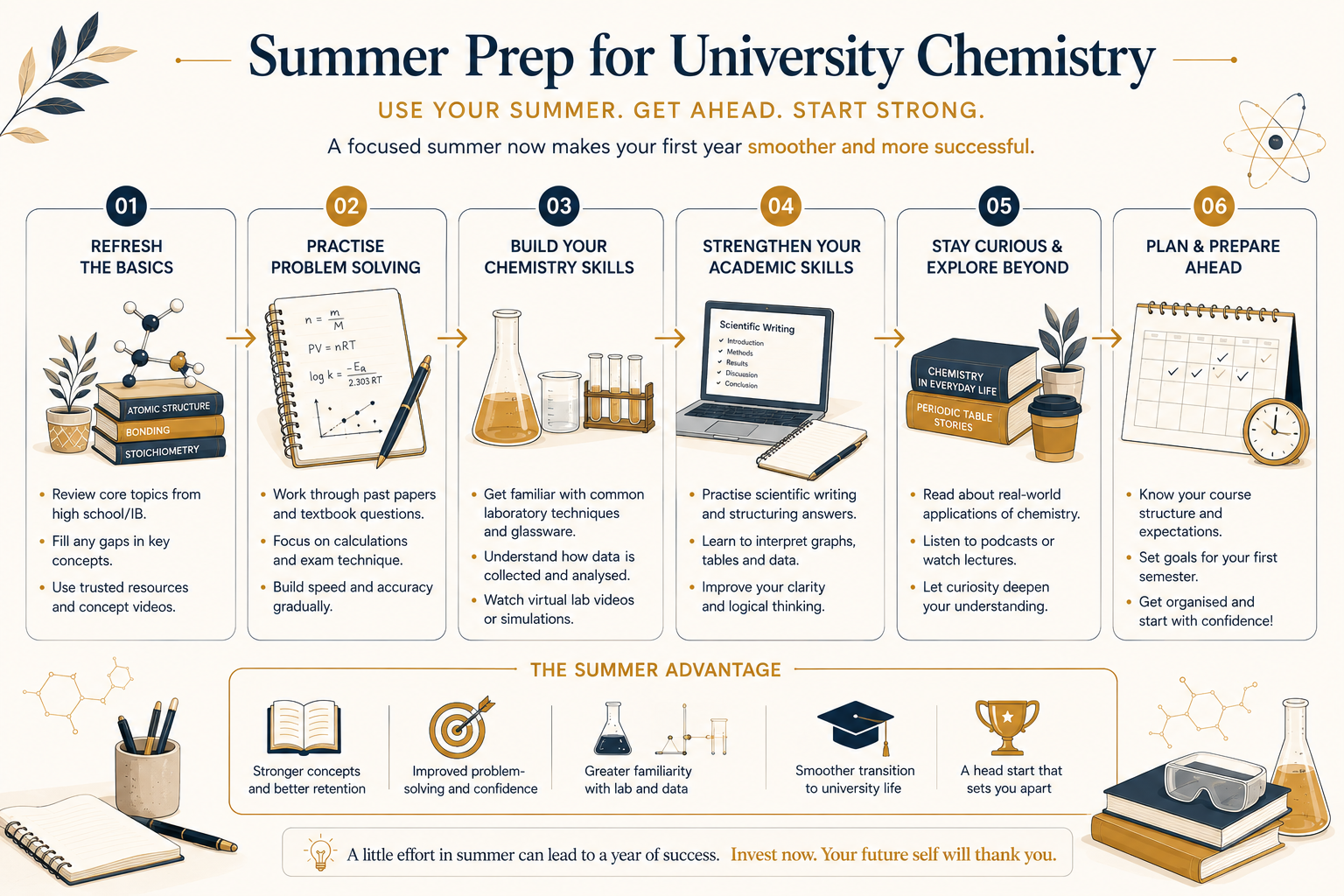
For students planning to study chemistry, biomedical science, or similar subjects, the most valuable summer preparation is usually not more chemistry content, but the math that chemistry relies on. Three areas are worth reviewing, no matter which IB math course you took: basic differentiation and integration (used often in physical chemistry and reaction kinetics), logarithms and exponentials (important for pH, equilibrium, and rate calculations), and being comfortable with dimensional analysis at a faster pace than IB usually requires.
It also helps to ask for the reading list or first-term syllabus from your chosen university program, if possible. Chemistry departments differ more than IB schools in what they expect you to know beforehand, and a real syllabus gives you better guidance than general advice. In addition, reading the abstract and methods section of a real research paper in your field is an easy way to connect your IA experience to university research writing.
Frequently Asked Questions
Is IB Chemistry harder than first-year university chemistry?
They’re difficult in different ways. IB Chemistry is broad and application-focused under exam-time pressure; university chemistry tends to go deeper into fewer topics and assumes greater mathematical fluency.
They’re difficult in different ways. IB Chemistry is broad and application-focused under exam-time pressure; university chemistry tends to go deeper into fewer topics and assumes greater mathematical fluency.
Does the IA really help prepare for university lab reports?
Yes, more than most students expect. The structure — methodology, data processing, uncertainty analysis, and evaluation of limitations — closely mirrors what a university lab report requires, often before students realize the connection.
Yes, more than most students expect. The structure — methodology, data processing, uncertainty analysis, and evaluation of limitations — closely mirrors what a university lab report requires, often before students realize the connection.
What if my school didn’t have great lab facilities?
That’s common, and it’s a gap that can be fixed with some guided practice on lab technique and data interpretation before starting university. It reflects the resources available at the time, not your ability.
That’s common, and it’s a gap that can be fixed with some guided practice on lab technique and data interpretation before starting university. It reflects the resources available at the time, not your ability.
Should I take a university-level chemistry review course over the summer?
Often, reviewing the underlying math (like calculus and logarithms) is a better use of summer preparation time than going over chemistry content again. Taking a quick, honest look at where your real gaps are is more helpful than a general review course.
Often, reviewing the underlying math (like calculus and logarithms) is a better use of summer preparation time than going over chemistry content again. Taking a quick, honest look at where your real gaps are is more helpful than a general review course.
Is HL Chemistry enough preparation for a chemistry-related degree, or should I have done more?
HL Chemistry is usually strong preparation. What matters more than HL versus SL is whether one’s understanding is solid. A well-understood SL foundation often helps more than a shaky HL background.
HL Chemistry is usually strong preparation. What matters more than HL versus SL is whether one’s understanding is solid. A well-understood SL foundation often helps more than a shaky HL background.
What’s the single biggest adjustment new chemistry-degree students report?
Almost everyone agrees that the biggest adjustment is the pace. University covers material much faster and expects you to teach yourself more from textbooks and lecture notes, compared to IB’s guided classroom style. Strong independent study habits from IB are a big help, even when the topics are new.
Almost everyone agrees that the biggest adjustment is the pace. University covers material much faster and expects you to teach yourself more from textbooks and lecture notes, compared to IB’s guided classroom style. Strong independent study habits from IB are a big help, even when the topics are new.
Does HL versus SL Chemistry matter for admission to competitive science programs?
Often, yes. Many competitive science and medicine programs specifically require or strongly prefer HL Chemistry, so it’s important to check the entry requirements for your target programs early instead of assuming SL is enough. Where SL is accepted, real understanding still matters more than which level you took.
Often, yes. Many competitive science and medicine programs specifically require or strongly prefer HL Chemistry, so it’s important to check the entry requirements for your target programs early instead of assuming SL is enough. Where SL is accepted, real understanding still matters more than which level you took.
Will my IB Chemistry grade itself matter once I’m actually at university?
For admission, yes, many programs set minimum grade requirements. Once enrolled, though, what matters day-to-day is the underlying understanding and study habits built while earning that grade, not the grade number itself.
For admission, yes, many programs set minimum grade requirements. Once enrolled, though, what matters day-to-day is the underlying understanding and study habits built while earning that grade, not the grade number itself.
Build a Stronger Chemistry Foundation Today
University may be the destination, but the foundation is built during high school. If you’re studying IB or A-Level Chemistry and want to strengthen your understanding, close knowledge gaps, and become more confident with unfamiliar problems, book a free 30-minute consultation. Let’s talk about where you are and how I can help.