The Psychology of a Chemistry Exam Taker: Why Smart Students Blank Under Pressure
Every year, I work with students who can explain a concept perfectly on a Tuesday afternoon and then can’t retrieve half of it three weeks later, in the exam hall. It isn’t a knowledge problem. It’s a psychology problem — and it’s one of the most under-discussed parts of IB Chemistry preparation. If you’ve ever walked out of a chemistry exam thinking “I knew that,” this post is about why it happens, what’s actually going on when it does, and what you can do about it before your next paper.
What's Actually Happening in Your Brain During a Chemistry Exam?
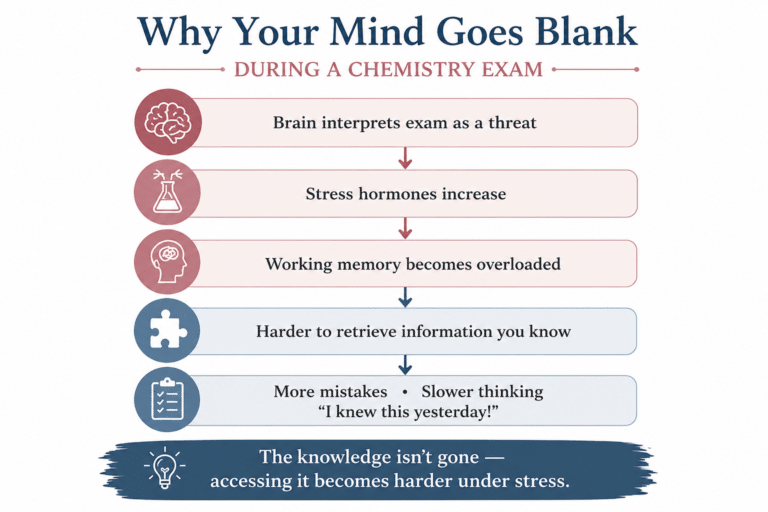
Under time pressure and the sense of being evaluated, your brain shifts its priorities. The stress response that helps you react quickly to a real threat isn’t especially good at supporting the kind of slow, deliberate, multi-step reasoning that a titration calculation or a mechanism question demands. When your brain reads an exam as a threat rather than a task, it starts competing for the same mental resources you need for working memory — the mental workspace where you hold a question, your relevant knowledge, and your working steps all at once.
This is why a student can “know” something and still go blank: the information hasn’t disappeared, but under stress, retrieving it and using it in a structured way becomes genuinely harder. It’s a real, physiological effect — not a character flaw, and not a sign the student didn’t prepare enough.
Why Chemistry Triggers This More Than Some Other Subjects
Chemistry is particularly vulnerable to this effect for a few reasons. Multi-step calculations compound: one small error in step two throws off everything after it, so any slip feels higher-stakes than in a subject where each answer stands alone. The subject is also notation-heavy — equations, mechanisms, and command terms all demand precise recall, not just a general sense of the topic. And IB Chemistry specifically leans on unfamiliar-context, application-based questions, which require flexible thinking under time pressure — exactly the kind of thinking stress impairs most.
Is It Anxiety, or a Content Gap?
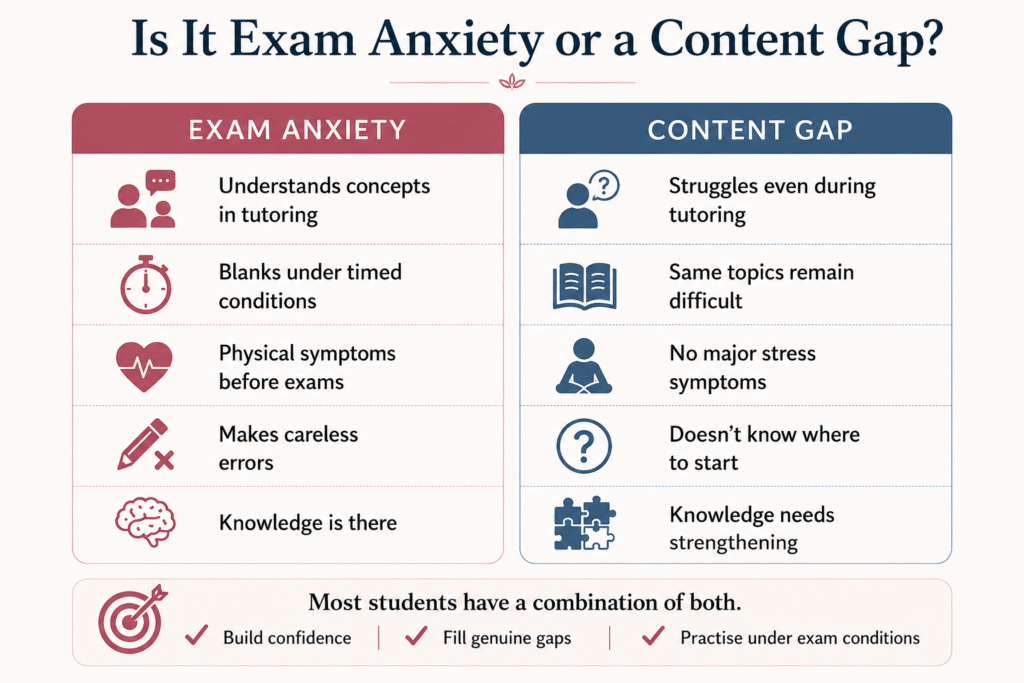
This distinction matters more than most students (and parents) realize, because the fix is completely different for each.
Signs it’s more anxiety than content:
- The student explains the concept calmly and correctly in a relaxed 1:1 setting, but underperforms on the same material under timed or mock-exam conditions
- They over-prepare — reviewing far more than needed — and still blank
- They report physical symptoms before or during exams: racing heart, a sudden blank at the sight of a question they clearly know
In-the-Moment Techniques That Actually Help
Read the whole paper first, and tick off your wins. Before answering anything, skim the full paper and mark the questions you know you can do. This does two things: it stops you from getting stuck on question one and running out of time for easier marks later, and it gives your brain concrete evidence — before you’ve even started writing — that this paper is manageable.
Start with a confidence question, not necessarily question one. If the paper structure allows it, answer something you’re sure of first. Early wins lower the perceived threat of the whole paper and make it easier to think clearly on the harder questions that follow.
Use slow, exhale-focused breathing before you start. A few seconds of deliberately slower breathing — with a longer exhale than inhale — genuinely helps down-regulate the stress response. This isn’t a soft add-on; it’s one of the few techniques with a direct physiological effect on the exact system that’s working against you.
Reframe the internal script. Shifting from “I have to get this exactly right” to “let me work through what I actually know” reduces the sense of threat and frees up the working memory that threat-thinking consumes.
Chunk multi-step calculations onto the page. Write out each step as you go rather than trying to hold the whole calculation in your head. This directly reduces the working-memory load that stress is already competing for — it’s not just neater working, it’s a genuine performance tool.
How I Build This Into My Tutoring Sessions
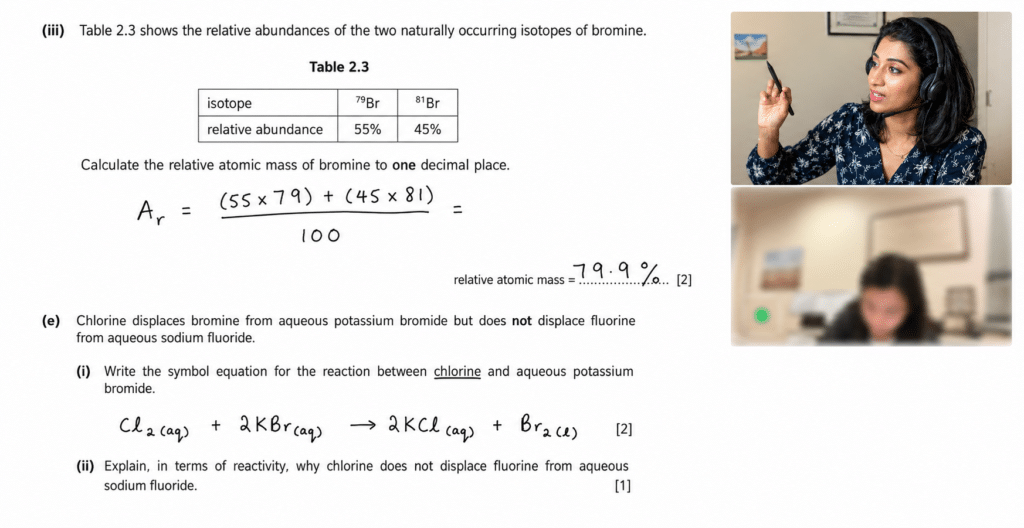
Content review only solves half the problem, so I don’t treat it as the whole solution. I introduce timed, exam-condition practice gradually rather than all at once, so the format itself stops feeling novel — and novelty is one of the biggest drivers of exam-day threat response. After every mock paper, we debrief on the why behind any blanks, not just the mark: was it a genuine gap, or a moment where stress got in the way of knowledge that was already there? That distinction shapes everything about what we work on next. Above all, my sessions are built to be a low-stakes space — students need somewhere they can be wrong without it feeling like a rehearsal for failure, so that the real exam isn’t the first time they’ve had to think clearly under pressure.
One Student's Turnaround
Vanessa had always done well in chemistry — until she got to IB. Within her first six months, her scores started sliding, and no matter how hard she tried to course-correct on her own, it kept getting worse. By the time her mother reached out to me, Vanessa was sitting at a Level 4, and six months of struggle had done as much damage to her confidence as to her grade. In our first session, when I asked her to work through a question, she looked up and said, “Rose, I don’t even know what the question is asking!” I told her that was exactly why she was there, and we started from the ground up — rebuilding the fundamentals she’d lost confidence in, moving quickly through what she already understood, and slowing down wherever the real gaps were.
Within a few weeks, she was answering confidently in our sessions — but her school chapter tests still didn’t reflect it. So I asked her to send me scans of her actual test answers, and the pattern became clear: careless slips, misread values, numbers swapped mid-calculation — not gaps in understanding, but errors in execution under test conditions. I built targeted practice around exactly those error patterns, and we worked through them together until the mistakes stopped showing up.
Three months later, Vanessa solved the same type of question that had once left her stumped — and handled harder variations of it without hesitation. She’d moved from a Level 4 to a Level 6. With ten months still to go before her final exams, she’s now aiming for a 7.
FAQs
Is chemistry exam anxiety common?
Can exam anxiety really affect a well-prepared student?
How do I know if it's anxiety and not a content gap?
How can a tutor help with this, not just with content?
What should I do the night before if I'm anxious?
If exam anxiety feels bigger than exam-day nerves — if it’s affecting sleep, appetite, or day-to-day wellbeing — that’s worth a conversation with a school counselor or doctor, not just a study strategy.
For most students, though, a mix of the right preparation and the right exam-day mindset makes a real difference. If you’d like a second opinion on which one your child needs, book a free consultation and we can talk through it together.