Chemistry Tutoring Online
What I’ve Learned Teaching Chemistry Online (And What Actually Helps Students)
Chemistry has always been one of those subjects that students either love or dread — rarely anything in between. After years of working as a chemistry tutor, I’ve seen both ends of that spectrum up close. And when I made the shift to teaching chemistry tutoring online, I honestly wasn’t sure what to expect. Would the screen create distance? Would students disengage? What I found instead surprised me.
Online tutoring didn’t water down the experience. In many ways, it made it better.
The Flexibility Factor Is Real — But It’s More Than Just Convenience
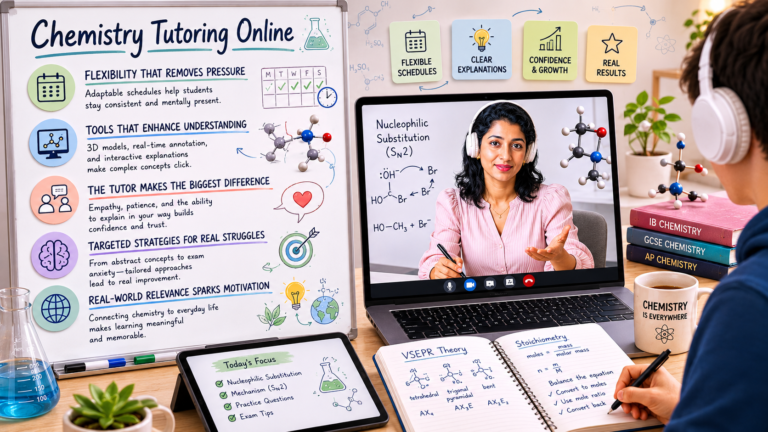
The first thing students notice when they move to online chemistry tutoring is the flexibility. You can fit a session around a part-time job, sports practice, or family responsibilities. But what I’ve come to appreciate as a tutor is that this flexibility does something deeper — it removes the pressure that often gets in the way of learning.
When a student isn’t rushing across campus or sitting in a rigid classroom schedule, they show up more present. They’re ready to actually think, not just survive the hour. That mental shift alone makes a big difference in how well concepts stick.
Zofia, one of my students, is a national athlete with only 50% school attendance. Balancing IB Chemistry HL with an elite training schedule would break most students. But because we could adapt sessions around training camps and exhausted evenings, she went from a 4 on her mocks to a 6 on her most recent past paper. Flexibility wasn’t just a convenience for her — it was the only reason consistent tutoring was possible at all.
The Tools Have Genuinely Changed How I Teach
I can understand that virtual teaching may first feel like a workaround for real teaching. Being able to draw out a reaction mechanism in real time, annotate a student’s working directly on screen, or pull up a molecular model mid-explanation — these aren’t compromises. They’re upgrades.
One thing I use regularly is 3D molecular modelling software, particularly when students are wrestling with spatial concepts. Carla, an IB student who came to me scoring 3s and close to giving up on chemistry, had never properly grasped VSEPR theory until I pulled up an online 3D molecular model mid-session. Suddenly, electron domains and bond angles made sense in a way no textbook diagram had managed. That kind of moment — an abstract concept suddenly becoming visual and real — happens just as often online as it ever did in person.
What Actually Makes a Good Online Chemistry Tutor
I get asked this a lot, and my honest answer is: qualifications matter, but they’re not the whole story.
Yes, you want someone with a solid background in chemistry — ideally postgraduate level, with real teaching experience across different levels. But beyond credentials, what I’d tell any student or parent looking for chemistry tutoring online is to pay attention to how the tutor explains things in the first session. Do they check in with you? Do they slow down when you’re confused without making you feel bad about it? Do they connect the chemistry to something real?
Annina, one of my IB Chemistry SL students, came to me in Year 13 scared of being judged for not understanding the material. She’d been struggling for over a year and had nearly convinced herself she simply wasn’t capable. What changed things wasn’t any single explanation — it was that she finally felt safe enough to ask questions without embarrassment. In her own words, the first time she truly understood chemistry was in her very first session with me.
Most platforms offer a trial session. Use it. Don’t just assess whether the tutor knows their chemistry — notice whether they can teach your version of confused.
The Struggles I See Most Often (And What Actually Helps)
The first thing students notice when they move to online chemistry tutoring is the flexibility. You can fit a session around a part-time job, sports practice, or family responsibilities. But what I’ve come to appreciate as a tutor is that this flexibility does something deeper — it removes the pressure that often gets in the way of learning.
When a student isn’t rushing across campus or sitting in a rigid classroom schedule, they show up more present. They’re ready to actually think, not just survive the hour. That mental shift alone makes a big difference in how well concepts stick.
Zofia, one of my students, is a national athlete with only 50% school attendance. Balancing IB Chemistry HL with an elite training schedule would break most students. But because we could adapt sessions around training camps and exhausted evenings, she went from a 4 on her mocks to a 6 on her most recent past paper. Flexibility wasn’t just a convenience for her — it was the only reason consistent tutoring was possible at all.
The Tools Have Genuinely Changed How I Teach
I can understand that virtual teaching may first feel like a workaround for real teaching. Being able to draw out a reaction mechanism in real time, annotate a student’s working directly on screen, or pull up a molecular model mid-explanation — these aren’t compromises. They’re upgrades.
One thing I use regularly is 3D molecular modelling software, particularly when students are wrestling with spatial concepts. Carla, an IB student who came to me scoring 3s and close to giving up on chemistry, had never properly grasped VSEPR theory until I pulled up an online 3D molecular model mid-session. Suddenly, electron domains and bond angles made sense in a way no textbook diagram had managed. That kind of moment — an abstract concept suddenly becoming visual and real — happens just as often online as it ever did in person.
Chemistry Is Everywhere — And Reminding Students of That Changes Everything
One thing I always try to weave into sessions is the real-world relevance of what we’re studying. A student struggling with reaction kinetics finds it a lot easier to care when we talk about how the same principles explain why food spoils faster in summer, or how a drug gets metabolised in the body.
Dhyana, who came to me for IB HL Chemistry support, is now studying medicine — in part because her chemistry results gave her the grades she needed to get there. When students see chemistry as the foundation of something they genuinely care about, rather than a hurdle to survive, the whole dynamic of learning shifts.
A Few Things I’ve Seen Work, Time and Again
From my experience with chemistry tutoring online, here’s what consistently separates students who improve from those who plateau:
Regular, shorter sessions beat marathon cramming. An hour twice a week will always outperform three hours the night before. The brain needs time to consolidate. Ying Ying came to me twice a week without exception — and never left anything unreviewed between sessions.
Active recall — explaining concepts back in your own words, working problems from memory — is far more effective than re-reading notes. I often ask students to summarise what they’ve learned every 10–15 minutes, or to teach the concept back to me. It’s uncomfortable at first. That discomfort is exactly the point.
Don’t skip the confusion. When something doesn’t make sense, that’s the signal to slow down and dig in — not to push through and hope it resolves itself. Breyanna, one of my IB HL Chemistry students, put it well: there’s no limit to questions in our sessions, and every question gets answered clearly. That accessibility matters more than most students realise before they experience it.
Real Stories: What Chemistry Tutoring Online Actually Looks Like
The best measure of whether any of this works isn’t what I say — it’s what students and parents say once they’ve lived through it.
Ying Ying came to me at the start of Year 12 as a self-described average student. What set her apart was her commitment. She came twice a week, asked precise questions, reviewed her mistakes, and worked hard outside our sessions. She scored a perfect 7 in her IB Chemistry predicted grades — and secured early admission to Johns Hopkins University for their highly competitive biomedical engineering programme. Six students from her school applied that year. She was the only one accepted.
Annina was in Year 13, failing IB Chemistry SL and convinced a tutor couldn’t help her. She was scared of judgment and doubted whether anyone could explain chemistry in a way that made sense to her. She gave online tutoring one try — and everything changed. We revisited difficult concepts, repeated ideas until they genuinely landed, and celebrated every small step forward. She passed every single exam, with scores she had never imagined possible for herself.
Carla started tutoring in November, scoring 3s and questioning whether she’d made the right decision taking chemistry at all. Over four months, we worked systematically through her gaps — using 3D models, past paper practice, and IB-specific exam strategies. Her grades climbed to consistent 5s. More than the numbers, what shifted was her belief in herself. She stopped feeling embarrassed to ask questions. She started approaching the subject she’d once dreaded with something closer to confidence.
Ilinca was a gifted student who found her school lessons too easy — until the content suddenly became more complex and she realised the foundational links had never been properly built. We worked step by step to fill those gaps, and she progressed quickly once the underlying structure was solid. Her parents noticed the change not just in her results, but in her attitude: she went back to approaching chemistry with genuine enthusiasm.
Jeffy put in consistent effort for a long time without the results to show for it. Stoichiometry kept tripping him up no matter how hard he tried. Once we worked through the underlying logic rather than the steps alone, it clicked. He went from a low mock grade to a two-grade improvement in his final IGCSE results.
What these students have in common isn’t a particular level, curriculum, or starting point. It’s that they each needed chemistry taught in a way that actually made sense to them — patient, structured, and responsive to where they were stuck.
Finding the Right Fit
Chemistry tutoring online works best when there’s a genuine match between how you learn and how your tutor teaches. Some students need a methodical, step-by-step approach. Others learn better through discussion, analogy, and lots of back-and-forth. Neither is wrong — they’re just different.
If you’re looking for an online chemistry tutor, think about what kind of support you actually need. Is it exam prep? Concept clarity? Building foundational confidence from the ground up? The clearer you are about that, the easier it is to find someone who can genuinely help.
Chemistry is learnable. I’ve seen students go from dreading it to choosing it as a career. I’ve seen students who were failing in November walk into May exams with real confidence. That change rarely comes from a single breakthrough moment — it comes from consistent, well-supported work with someone who knows how to meet you where you are.
That’s what good chemistry tutoring online looks like. And if that’s what you’re looking for, the right tutor makes all the difference.
If chemistry has been feeling confusing or frustrating, sometimes the right explanation changes everything.
Chemistry Doesn’t Have to Feel Overwhelming
Over the years, I’ve learned that students rarely need more pressure—they usually need clearer explanations, patience, and the right strategy. If that sounds like the kind of support you’re looking for, I’d be happy to help.