GCSE Chemistry Tutors Near You: Helping Struggling Students Build Confidence and Clarity
Why So Many Students Struggle with GCSE Chemistry
Many parents worry when their child struggles with Chemistry — but that’s completely normal and it’s not a sign of weakness.
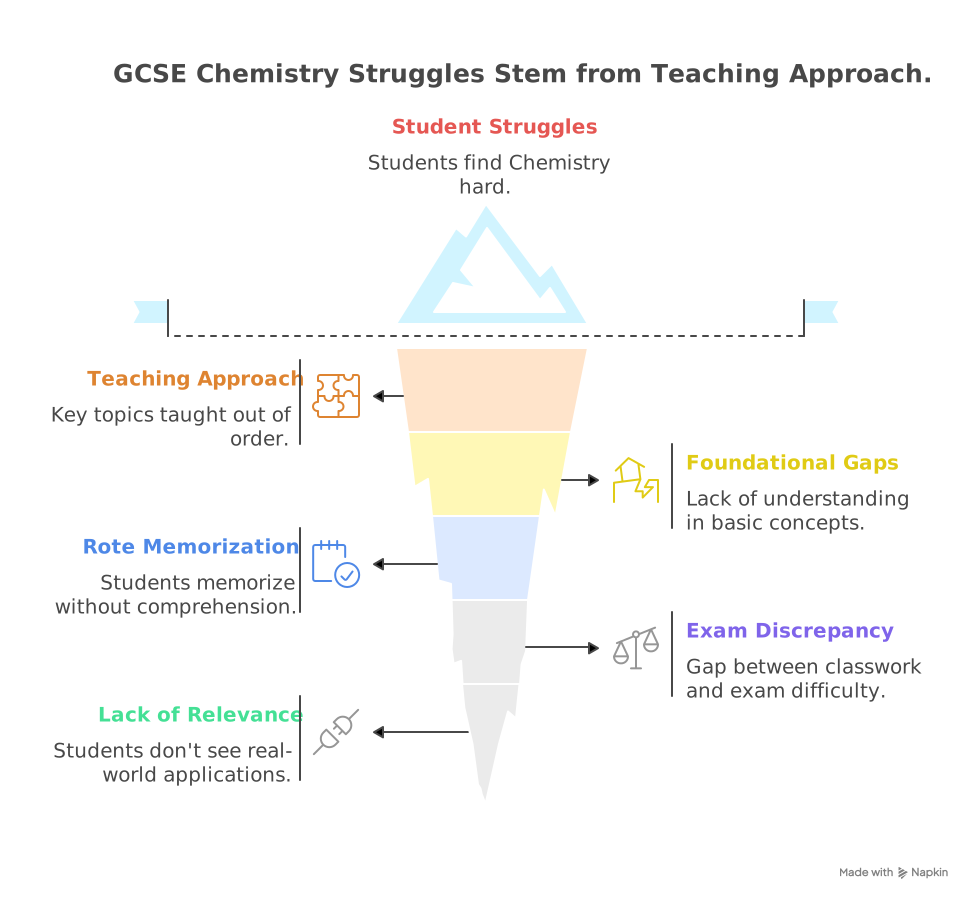
From my 18+ years of teaching experience across GCSE, A-Level, IB, and AP, I’ve learned that most students find Chemistry hard because of the teaching approach, not because they lack potential.
In most GCSE curricula, key foundational topics are often taught after advanced ones. This creates a gap that leaves students confused and disengaged.
Example: Why Electrolysis Feels So Difficult
In almost every GCSE syllabus, electrolysis is taught before redox reactions.
Yet electrolysis involves a redox process — electrons are transferred during reduction and oxidation. When students haven’t learned redox first, electrolysis becomes a collection of rules to memorize, not a concept to understand.
That’s why I start by introducing redox principles early — showing how oxidation and reduction underpin electrolysis.
This way, students see Chemistry as a connected story rather than scattered facts.
How I Rebuild Understanding — Without Wasting Time
Parents often worry that filling foundational gaps might “slow down” their child. In reality, it does the opposite.
I teach in parallel with the school curriculum, so students stay aligned with their classes.
But whenever a topic rests on shaky ground, I spend a few short minutes strengthening that foundation — just enough for the current topic to make sense. They can now be better involved in their lessons at school, and most of my students begin to actively participate in their Chemistry classes and surprise their teachers. They’d come to me in their next lesson saying, “..and I was the only one who got it right!”
For example:
If a student is studying rates of reaction, we revisit collision theory and activation energy briefly.
If they’re working on ionic bonding, we review electron configuration first.
These “micro-bridges” save hours of frustration and prevent confusion from snowballing later.
A Real Story: From Disinterest to Curiosity
One parent — herself a science teacher — reached out to me saying her son, Lee, simply “hated Chemistry.” He didn’t want a tutor, and he wasn’t curious about the subject, and she’s given up teaching him.
During our first lesson, he told me he didn’t understand “something called the shielding effect”.
I explained how shielding and effective nuclear charge together explain trends in atomic size and related properties like ionization energy and electronegativity.
For the first time, he saw how one principle connected to many others.
His eyes lit up, leaned forward; he started asking insightful questions.
By the end of the session, he said:
“Miss, when is our next lesson?”
When students see the logic behind Chemistry, it stops being a mystery — it becomes a language they can finally speak.
Why Textbooks (and Even Schools) Get the Sequence Wrong
Many GCSE textbooks introduce topics based on syllabus order rather than conceptual logic.
That’s why even bright students end up memorizing disconnected facts.
For instance, polymers are often introduced early in the course, long before students have learned the organic reaction mechanisms behind them. The key organic reactions — such as addition and condensation — are usually taught much later in the syllabus. As a result, students are forced to memorize how polymers are formed without truly understanding the chemistry behind them.
By teaching Chemistry in its natural, logical order, I help students build understanding step by step — so every new idea feels like a continuation, not a contradiction.
The Problem with Easy Classwork and Hard Exams
Another common reason students lose confidence is the gap between classwork and real exam questions.
In schools, exercises are often simplified to fit short lessons. But during exams, the questions require analytical thinking and multi-step reasoning.
That’s why, in my lessons, I integrate exam-style questions early on.
Students learn how to recognize question patterns, analyze keywords, and apply mark-scheme logic — skills most students only develop far too late.
By the time my students take their GCSEs, they’ve already seen how examiners think.
How True Understanding Builds Motivation
Motivation doesn’t come first — understanding does.
When students grasp why a concept matters and how it applies to real life, their curiosity naturally follows.
Chemistry starts to feel relevant: how electrolysis links to industry, how redox reactions power batteries, how molecular shapes explain medicine and materials.
Once students experience that “aha” moment, their confidence grows — and so do their grades.
Why Online Tutoring Works So Well
Many parents worry online lessons might not be as effective as face-to-face tutoring.
But with today’s interactive tools, online learning often delivers better results.
I use a shared whiteboard for real-time diagrams and calculations, digital past papers for exam prep, and visual models to simplify abstract concepts.
This allows me to work seamlessly with students across time zones — from the UK to Singapore — while maintaining the same personalized connection and feedback as in-person tutoring.
Curious if online tutoring actually works? Read more to find out what I’ve learned from years of experience!
Who I Work With
I specialize in working with:
IB, AP,IGCSE/GCSE, A-level students (AQA, Edexcel, Cambridge, OCR Chemistry and more)
Students in international schools following the UK/ International curriculum.
Learners who feel “stuck” or overwhelmed but are capable of much more.
- High achieving learners who feels bored with the slow pace of class-room teaching and don’t feel challenged enough.
FAQs About GCSE Chemistry Tutoring
Q1: What should I look for in a GCSE Chemistry tutor?
Q2: Can online Chemistry tutoring be as effective as in-person lessons?
Q3: How many sessions does it take to see improvement?
Q4: What exam boards do you teach (AQA, Edexcel, Cambridge and OCR Chemistry)?
Q5: My child dislikes Chemistry. Can tutoring really change that?
About the Tutor
Rose Kurian, MSc Chemistry Online Chemistry Tutor | National Tutor Award Finalist (Tutors’ Association UK)
With nearly 20 years of experience teaching GCSE, A-Level, IB, and AP Chemistry, Rose Kurian helps students around the world develop a deep and confident understanding of Chemistry.
She specializes in bridging learning gaps, strengthening conceptual clarity, and guiding students toward top exam performance.
Her teaching approach blends logical sequencing, real-world relevance, and empathetic mentorship — transforming not just how students learn Chemistry, but how they see their own potential.
Ready to Help Your Child Succeed in GCSE Chemistry?
Whether your child is in London, Dubai, or Singapore, expert help is just a click away.
Book a free consultation or email me at rose@onlinechemistrytutorrose.com to discuss your child’s goals and discover how personalized, step-by-step online tutoring can make Chemistry finally make sense.